



The Best Twilio Alternative for AI Agents
Deploy voice AI without building telecom infrastructure
Seamly is a managed telephony alternative to Twilio for teams deploying AI voice agents. Where Twilio gives you programmable building blocks (SIP, TwiML, webhooks) and asks you to operate the underlying voice infrastructure, Seamly delivers carrier connectivity, routing, monitoring, and EU hosting as a managed layer. Your team builds the AI agent. Seamly runs everything required to make it reachable by phone.

Two solutions, one challenge
As AI agents expand beyond chat and text-based interactions, voice quickly becomes the next logical step. At that point, most teams face a choice:
-
Build and operate their own voice infrastructure using a programmable CPaaS like Twilio
-
Use Seamly as a managed telephony infrastructure layer purpose-built for AI agents
Both approaches can support voice AI deployments. The difference lies in operational ownership, implementation complexity, and the amount of telecom expertise required to scale reliably.
Seamly
Twilio
The core difference
The difference between Seamly and Twilio is not feature depth. It is ownership. Twilio is designed for teams that want to operate and customize their own voice infrastructure. Seamly is designed for platforms that want to deploy voice AI without becoming telecom operators.
Developer-centric voice infrastructure
It also means the platform itself becomes responsible for routing logic, failover handling, infrastructure monitoring, telecom operations and carrier management. For organizations with dedicated telecom and backend engineering teams, this model can make sense. For platforms focused primarily on orchestration and conversational intelligence, it often creates a parallel operational domain outside the core product.
Managed telephony infrastructure for AI agents
Your platform remains focused on the AI agent experience itself. Seamly handles the infrastructure required to run voice reliably at scale.
Infrastructure ownership
This model offers architectural control, but operational complexity increases as deployments grow.
Managed end-to-end
Every new deployment runs on the same managed infrastructure layer without requiring additional telecom operations from your internal team.
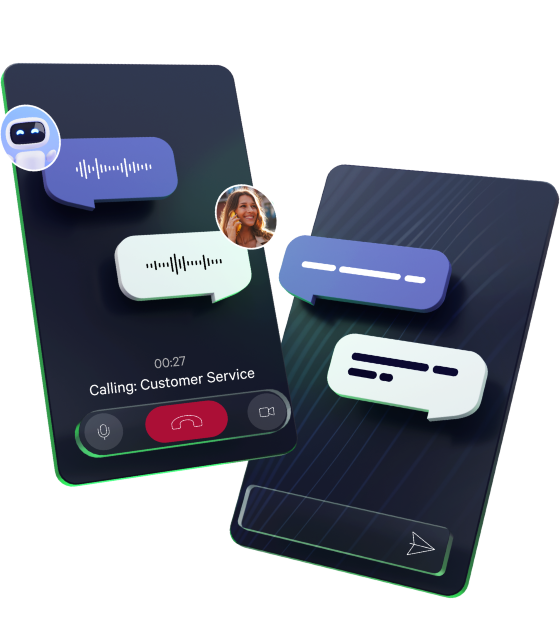
From text-based AI to voice AI
For many AI agents, the challenge is not simply adding telephony. The real challenge begins after the first phone call. Voice interactions introduce operational and conversational complexity that simply doesn’t exist in text-based environments.
-
interruption handling
-
latency management
-
turn-taking behavior
-
fallback routing
-
real-time orchestration
-
call reliability
Seamly supports platforms during this transition from text-based AI experiences to production-ready voice agents. We call this voicification. That includes both the telephony layer and the operational realities of deploying voice AI in real-world environments.
European infrastructure by design
Seamly is fully built and hosted in Europe. For platforms operating in European markets, infrastructure location increasingly matters for:
-
data residency requirements
-
procurement processes
-
enterprise governance
-
operational trust
-
GDPR-sensitive deployments
Twilio operates globally with infrastructure choices varying by setup and configuration.

Comparison overview
| Seamly | Twilio | |
| Technical model | Managed infrastructure layer | Programmable API’s |
| Operational ownership | Managed by Seamly | Managed internally |
| Time to first production call | Days to a few weeks | Weeks to months |
| Required expertise | Integration & AI focus | Telecom & backend engineering |
| Infrastructure management | Included | Internal responsibility |
| Multilingual support | 110+ languages via real-time translation included | DIY via STT/TTS provider choice |
| Scalability | Scales without added overhead | Scalable operations grow with you |
| From text to voice AI transition support | Included | Self-managed |
| Support model | Dedicated partner support | Documentation & support tickets |
| Speech engines | Best-in-class STT/TTS integrated, including voice cloning | Bring your own or use Twilio's, billed per provider |
| Hosting | Fully EU built & hosted | Global, configuration dependent |
Predictable pricing for unpredictable call volumes
Twilio pricing is usage-based and typically expands as additional voice capabilities are introduced. Speech recognition, voice synthesis, recordings, transcripts, and analytics are commonly billed separately, making operational forecasting more complex as deployments scale. Seamly uses a predictable pricing structure per voicebot call, including: speech recognition, voice synthesis, recording, transcripts, insights, and full EU hosting. No additional telecom components or infrastructure services need to be configured separately.
| Seamly | Twilio | |
| Pricing model | Fixed price per voicebot call | Usage-based |
| STT | Included | Additional cost |
| TTS | Included | Additional cost |
| Call recording | Included | Additional cost |
| Transcripts | Included | Additional cost |
| Advanced insights | Included | Additional cost |
| Hosteding | Fully EU hosted | Depends on deployment setup |
When to choose which?
The right choice depends on where you want to invest operational ownership. Here's an honest overview.
Choose Seamly when
- You want to deploy voice AI without operating telecom infrastructure
- Your focus is AI orchestration, customer experience, or agent intelligence
- You want to move from text-based AI to voice quickly
- Your team does not want to manage SIP routing, carrier operations, or telecom reliability
- You want a managed infrastructure layer with dedicated support
- European hosting and data residency matter to your customers
Choose Twilio when
- Your engineering team wants full architectural control
- You require highly customized telecom behavior or workflows
- You already operate telecom infrastructure internally
- You want direct ownership over routing, carrier integrations, and infrastructure logic
- Long-term infrastructure customization outweighs operational simplicity
Frequently Asked Questions
What can I use instead of Twilio?
The alternative you choose depends on what you're trying to build. Twilio gives you the building blocks, with APIs for telephony, programmable voice, SMS, and developer documentation. You assemble and operate the voice stack yourself.
Seamly takes a different approach. We deliver a managed voice AI layer, with carrier connectivity, call routing, monitoring, EU hosting, and integrated STT and TTS, so your team focuses on the AI agent logic instead of the telecom plumbing.
If you're deploying AI agents that need to speak naturally, scale predictably, and run on European infrastructure, Seamly is built for that exact use case. Voicification (turning a chatbot or AI agent into a phone-ready experience) is what we do.
Who is Twilio's biggest competitor?
Twilio competes in several overlapping markets, and the strongest competitor depends on your needs. In CPaaS messaging, several developer-focused platforms compete on price. In contact-centre voice, traditional and cloud contact centre vendors dominate.
For voice AI specifically, the layer that turns AI agents into phone-ready experiences, Seamly is the practical choice for teams that don't want to build telephony infrastructure themselves. Seamly delivers managed connectivity, EU hosting, and integrated speech engines as a single layer on top of your AI agent.
The right comparison depends on whether you're building voice infrastructure or deploying voice intelligence.
Does Twilio offer voice?
Yes. Twilio's Programmable Voice API lets developers make and receive calls, route them, and stream audio to other services. It's a foundation you build on, not a pre-built voice agent.
For an AI voice agent, the Twilio Voice API is one part of a longer chain. You also need an STT engine, a TTS engine, an LLM, latency tuning, interruption handling, and call orchestration. Each of those is your responsibility.
Seamly takes a different route. We hand you a managed voice layer with all of those components already integrated and tuned, so your team only configures the AI agent logic. Voicification is the goal: your AI agent answers the phone, and the infrastructure handles itself.
How much do AI voice agents cost?
The cost depends on how the underlying voice infrastructure is priced. Developer-focused platforms typically bill per second of call time, plus separate line items for carrier, STT, TTS, and any AI services. That gives flexibility, and it makes monthly costs harder to forecast, especially for long or unpredictable conversations.
Seamly uses a fixed per-call pricing model. Carrier connectivity, STT, TTS, and orchestration are included. Call length doesn't surprise the bill, and that's a deliberate choice. Voice AI agents often handle longer conversations than traditional IVRs, and unpredictable per-second costs hurt unit economics.
Beyond pricing, total cost includes the engineering hours you spend operating the infrastructure. Seamly's managed model removes that ongoing cost line entirely.
The real decision: build infrastructure or deploy voice AI
Twilio gives you the flexibility to build and operate voice infrastructure themselves.
Seamly removes that operational burden entirely and provides a managed telephony layer purpose-built for AI agents.
For platforms where voice is a capability to deploy rather than an infrastructure domain to own, that distinction becomes increasingly important as deployments scale.
Discover how Seamly helps platforms deploy voice AI without telecom complexity.