


Skip to content
3D Illustration of multiple flat rectangular planes with a glowing orb on top of it, surrounded by different services
Background 1

The Best AudioCodes Alternative for AI Agents

Bring AI agents to the phone without managing telecom infrastructure

Seamly is a managed telephony alternative to AudioCodes for organizations deploying AI voice agents over the phone. AudioCodes is built for enterprises that already operate telecom infrastructure, like SBCs, SIP gateways and internal voice engineering. Seamly is built for platforms that want voice as a capability, not an infrastructure domain to own. Fully EU-hosted, deployable in 2-6 weeks, and managed end-to-end.


Two fundamentally different starting points

As AI agents move beyond chat interfaces and into real-time voice interactions, telephony becomes part of the architecture. At that point, organizations typically follow one of two routes:

  • Extend an existing telecom environment toward AI using infrastructure solutions like AudioCodes

  • Start from the AI platform itself and add managed telephony infrastructure through Seamly

Both approaches can support voice AI deployments. The difference lies in operational ownership, required expertise, and the role telecom infrastructure plays inside your organization.

Seamly

Intelligence-first telephony infrastructure for AI agents. Seamly starts with the AI agent platform and delivers the complete telephony infrastructure required to deploy voice AI in production. Carrier connectivity, routing, number management, monitoring, and operational support are fully managed. Your AI platform handles the intelligence. Seamly handles everything required to make AI agents reachable by phone.

AudioCodes

Infrastructure-first voice architecture. AudioCodes originates from enterprise telephony infrastructure. Products like SBCs, gateways, and VoiceAI Connect extend existing telecom environments toward AI integrations. The architecture assumes ownership of a telephony environment and focuses on connecting AI systems into that infrastructure stack.

The core difference

AudioCodes is designed for organizations that already operate telecom infrastructure. Seamly is designed for platforms that want to deploy AI agents over telephony without becoming telecom operators themselves. That difference affects things like implementation complexity, operational ownership, infrastructure dependencies and required expertise.

Logo of AudioCodes

Telecom infrastructure extended toward AI

AudioCodes VoiceAI Connect acts as a bridge between an existing SIP-based telephony environment and conversational AI platforms. It assumes you already have (or are procuring) a voice infrastructure: SBCs, SIP trunks, carrier connections. The product configures that existing stack to route calls to bots.


For enterprises with a mature telephony estate, this is a natural extension. For platforms and integrators without telecom infrastructure already in place, it introduces a new operational domain that must be designed, configured, and maintained before voice AI can scale reliably.

Logo of Seamly

Managed telephony infrastructure for AI agents

Seamly starts from the AI platform, not the phone system. It provides a complete managed telephony infrastructure layer purpose-built for deploying AI agents over voice channels, including: carrier connectivity, number provisioning, routing infrastructure, monitoring and SLA management and AI voice deployment expertise.


There is no requirement for existing telecom infrastructure, SIP expertise, or in-house telephony operations. Your team focuses on AI orchestration and customer experience. Seamly handles the infrastructure required to run voice AI reliably in production.

Logo of AudioCodes

Infrastructure ownership remains internal

AudioCodes products are designed for IT administrators, enterprise telecom teams, and service providers who are already comfortable managing voice infrastructure. Deploying VoiceAI Connect means working with SBC configuration, SIP routing logic, and carrier interconnects.


This model fits organizations with established telecom teams and existing voice estates. Operational ownership remains part of the internal environment.

Logo of Seamly

Managed end-to-end

Seamly delivers telephony infrastructure as a managed service for AI agent platforms. Carrier management, routing infrastructure, scaling, monitoring, and telecom operations are fully handled by Seamly. Every deployment runs on the same managed infrastructure layer without requiring telecom engineering resources internally. The result is faster deployment with significantly lower operational overhead.

From text-based AI to voice AI

Deploying AI agents over telephony introduces operational and conversational complexity that does not exist in text-based environments. The challenge is not simply connecting a phone number. Telephony conversations are often more messy than chat, because callers interrupt, change direction mid-sentence, speak with background noise, use unclear phrasing, and expect immediate, natural responses. 

That means voice AI agents need more than a text-based conversation flow. They need to handle turn-taking, latency, fallback logic, call transfers, escalation paths, and real-time context without breaking the caller experience.

AudioCodes primarily solves telecom interoperability challenges. Seamly supports the broader operational transition from text-based AI interactions to production-ready voice agents, a process we call voicifaction.

That includes both the telephony infrastructure and the operational realities of running AI voice experiences in real-world environments.
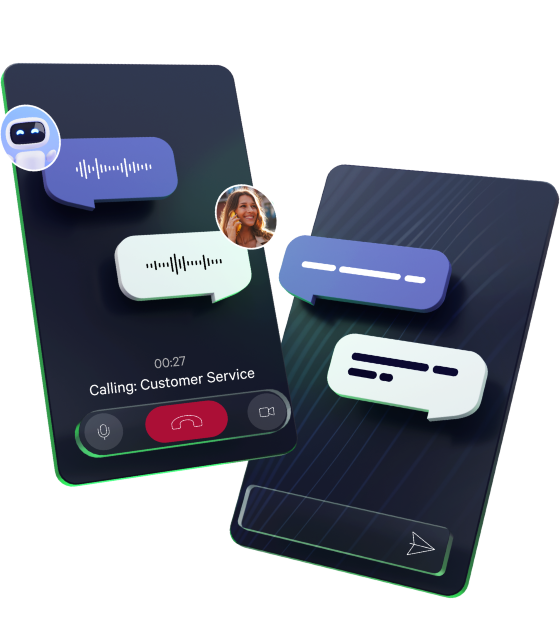

A 3D illustration showing a voice call on the left, and a written chat conversation on the right, with Seamly connecting the two in the middle.
Background 3

European infrastructure by design

Seamly is fully built and hosted in Europe. For organisations deploying AI agents in European markets, infrastructure location increasingly matters for:

  • data residency requirements

  • procurement and governance

  • enterprise compliance expectations

  • operational transparency

  • GDPR-sensitive deployment

Seamly operates with a Europe-first infrastructure model by default.

3D Illustration of the Seamly logo overlaying two floating panels surrounded by stars as on the EU flags
Background 1

Comparison overview


Dimension Seamly AudioCodes
Starting point AI agent platform Existing telephony environment
Technical model Managed infrastructure layer SBC & VoiceAI Connect gateway
Operational ownership Managed by Seamly Managed internally
Required expertise AI orchestration & integration Telecom engineering & SIP expertise
First time to production call Days to weeks Weeks to months
Infrastructure dependency None Existing or newly deployed telecom stack
Multilingual 110+ languages via real-time translation included Available, configuration dependent
Scalability Managed scaling Internally operated scaling
Voice AI transition support Included Telecom-focused
Support model Dedicated partner support Channel partners & professional services
Data residency & hosting Fully EU built & hosted Deployment dependent

When to choose which?

The right fit depends primarily on where telecom ownership should live inside your organization.

Logo of Seamly

Choose Seamly when

  • You want to deploy AI agents over voice channels without operating telecom infrastructure
  • Your focus is AI orchestration, automation, and customer experience
  • You want to move from text-based AI to voice quickly
  • Your team does not want responsibility for SBCs, SIP routing, or carrier operations
  • You want a managed infrastructure layer with operational support included
  • European hosting and data residency matter to your customers
Logo of AudioCodes

Choose AudioCodes when

  • Your organisation already operates enterprise telephony infrastructure
  • You have telecom engineering expertise internally
  • You need deep control over SIP infrastructure and interoperability
  • Your architecture is centred around extending existing telecom environments toward AI
  • Long-term infrastructure ownership outweighs operational simplicity

Make your conversation Seamly!

Who are AudioCodes competitors?

AudioCodes competes across two adjacent markets: traditional Session Border Controllers and enterprise SBC hardware, and the voice AI layer that connects telephony to conversational AI platforms. The competitors in each market are different.

For the voice AI layer specifically (turning AI agents into phone-ready experiences) Seamly is a direct alternative. The difference is in the starting point. AudioCodes extends your existing telephony estate, requires internal telecom expertise, and bridges to your AI platform. Seamly delivers managed voice infrastructure end-to-end, so you don't need an SIP environment or internal telecom team to deploy.

If you already have AudioCodes hardware and SIP infrastructure, extending it makes sense. If you're starting with AI agents and want to deploy in 2 to 6 weeks, Seamly is the more direct route.

What is AudioCodes used for?

AudioCodes is primarily known for voice networking infrastructure: Session Border Controllers, SIP gateways, IP phones, and software that connects enterprise telephony estates to platforms like Microsoft Teams. It's an infrastructure-first vendor with deep roots in carrier-grade voice.

More recently, AudioCodes extended into voice AI through its VoiceAI Connect product, which bridges existing telephony systems with bot frameworks and speech services. The deployment model assumes you already have SIP infrastructure to extend.

Seamly takes the opposite starting point. We provide the full voice layer, with carrier, STT, TTS, orchestration, and EU hosting as a managed service. There's no requirement for existing telephony infrastructure.

What is the best AI voice agent platform?

The "best" platform depends on what you bring and what you're willing to operate. For teams with existing SIP infrastructure and an internal telecom function, an infrastructure-first product that extends what they have can make sense. For teams starting from an AI agent and a phone number, an intelligence-first managed platform is the faster path.

Seamly fits the second case. We deliver managed carrier, STT, TTS, orchestration, EU hosting, and dedicated support as a single layer. Deployment takes 2 to 6 weeks, and the operational burden (monitoring, latency tuning, fallbacks) sits with us.

What matters most for "best" is the match between your team's strengths and the platform's deployment model. Voicification, done well, removes work; it doesn't add a new specialism.

How to make voice AI agents?

An voice AI agent needs different layers: a carrier connection to the telephone network, a speech-to-text engine, a reasoning engine (LLM, rule engine, or both), a text-to-speech engine, and an orchestration layer that handles turn-taking, latency, fallbacks, and call transfers.

In an infrastructure-first build, your team selects, integrates, and operates each layer. That's flexibility, and it's also ongoing engineering work, much of it specialist telecom expertise that most product teams don't have in-house.

In an intelligence-first approach, a managed platform delivers the carrier, speech engines, and orchestration as a single layer. Your team designs the AI agent itself (what it knows, how it speaks, when it escalates) and the voice infrastructure runs underneath. Seamly is built for this model, with EU hosting and 2-to-6-week deployment.

Infrastructure-first or intelligence-first

AudioCodes approaches AI voice from the telecom side. Seamly approaches telephony from the AI side.

That difference determines whether your organization spends time operating telecom infrastructure or deploying AI agents.

For platforms and system integrators that want to bring AI agents to the phone without building or managing telecom environments themselves, Seamly provides the managed infrastructure layer required to do that reliably and at scale.

Discover how Seamly helps platforms deploy voice AI without telecom complexity.

3D Illustration of stacked squares that represents layers of integrations
Background 1